AFC East Draft Review: Grading Rivals' Roster Improvements
The AFC East consistently ranks among the most competitive divisions in the NFL, a battleground where every offseason decision can significantly impact the race for supremacy. With the 2024 NFL Draft now concluded, it's an opportune time to dissect how each team's AFC East rivals approached the draft, aiming to bolster their rosters and gain an edge. While the New England Patriots embarked on a long-term rebuild under first-year head coach Jerod Mayo, their divisional counterparts—the Buffalo Bills, Miami Dolphins, and New York Jets—are all in different stages, largely focused on contending for a Super Bowl in the near future. How did these teams fare in their quest for roster improvement, and what do their draft classes signal for the season ahead?
The Buffalo Bills: Reinforcing a Shaken Defense
The Buffalo Bills have been the undisputed kings of the AFC East for the past four seasons, a testament to their consistent double-digit win campaigns and a defense that has frequently ranked in the league's top five. However, sustained success often comes with a hefty price tag. The Bills faced significant salary cap constraints this offseason, leading to the departure of several key defensive stalwarts, including Pro Bowl cornerback Tre'Davious White and safety Jordan Poyer. With veteran Micah Hyde also potentially not returning, Buffalo's once-formidable secondary found itself severely depleted, relying on relatively inexperienced players like projected starting safeties Taylor Rapp and Mike Edwards, along with backups Damar Hamlin and Cam Lewis.
Understanding this critical need, it's no surprise that the Bills' draft strategy heavily leaned towards shoring up their defense. Their draft class reflects a clear intent to get bigger, tougher, and more physical, a characteristic Buffalo has often leveraged against its divisional opponents, particularly the Miami Dolphins. Let's look at their key picks:
- Pick 30: Maxwell Hairston, CB, Kentucky: A first-round cornerback signals an immediate need for outside help. While some pre-draft analysts had questions, Hairston's fit in the Bills' system, opposite breakout star Christian Benford, could be excellent. He's expected to compete for a starting role right away, an essential move to mitigate the loss of White.
- Pick 41: T.J. Sanders, IDL, South Carolina: Buffalo continued its defensive focus by grabbing a high-impact interior defensive lineman. Sanders brings power and disruption, which will be crucial for maintaining a strong run defense and pressuring the quarterback from the inside.
- Pick 72: Landon Jackson, DL, Arkansas: Another versatile defensive lineman, Jackson adds depth and rotational capability to an already robust front.
- Pick 109: Deone Walker, IDL, Kentucky: Doubling down on interior defensive line talent with Walker underscores the Bills' commitment to dominating the trenches. This pick further enhances their physicality, an area where they consistently outperform many of their AFC East rivals.
- Later Picks: Jordan Hancock (CB, Ohio State), Dorian Strong (CB, Virginia Tech): The Bills didn't stop at Hairston; adding more cornerback depth in the later rounds suggests a comprehensive effort to rebuild their secondary. This is a smart approach, as you can never have too many talented defensive backs in today's pass-happy NFL.
Our Take: The Bills' draft class is a direct response to their offseason losses. By investing heavily in defensive linemen and cornerbacks, they've attempted to re-establish the defensive identity that has fueled their recent success. While the depth and experience in the secondary remain a question mark, the influx of talent is undeniable. This class means Buffalo's defense might be a little bit better this season, especially up front. However, it's worth noting they did little to significantly upgrade Josh Allen's receiver room, which remains solid but perhaps not elite. This could be an area where Bills' Secondary Struggles: A Threat to Their AFC East Reign? could still be a legitimate concern if their new defensive backs don't develop quickly.
New England Patriots: Charting a New Course
Under new leadership with Jerod Mayo taking the helm, the New England Patriots are clearly in a rebuilding phase. After mostly standing pat in free agency to maintain cap space, the draft was their primary avenue for injecting new talent and defining their future identity. Armed with an early pick, the Patriots had a significant opportunity to acquire foundational pieces.
Their draft class highlights a commitment to building from the trenches and finally providing more offensive support for their quarterback (whoever that may be, as they did not draft one in the first round).
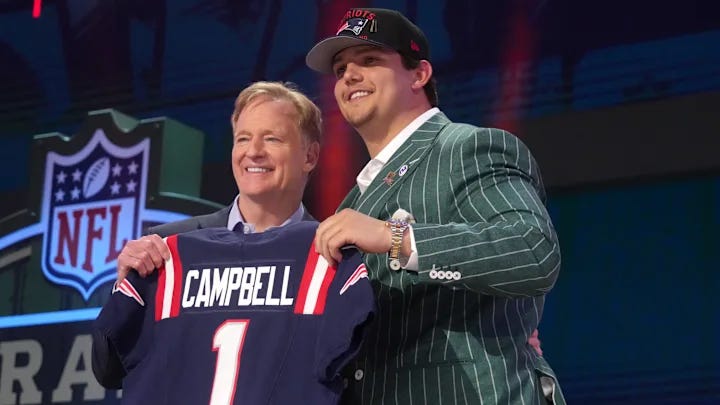
- Pick 4: Will Campbell, OL, LSU: Securing a top-tier offensive lineman with their first pick is a classic foundational move. Campbell immediately upgrades a unit that has struggled in recent years, providing crucial protection and run-blocking prowess. This is a cornerstone piece for any rebuild.
- Pick 38: TreVeyon Henderson, RB, Ohio State: Adding an explosive running back like Henderson in the second round gives the Patriots a dynamic threat out of the backfield, capable of contributing both as a runner and a pass-catcher. This is a significant injection of skill-position talent.
- Pick 59: Kyle Williams, WR, Washington State: Addressing the long-standing need for legitimate receiving threats, Williams brings speed and playmaking ability to a receiver room that has lacked consistent production.
- Pick 95: Jared Wilson, C, Georgia: Further solidifying the offensive line, Wilson provides depth and potential competition at center, demonstrating the Patriots' commitment to winning up front.
- Later Picks: Craig Woodson (SAF, California), Joshua Farmer (IDL, Florida State), Bradyn Swinson (EDGE, LSU): These defensive additions provide depth and competition across various positions, indicating a balanced approach to improving the roster from top to bottom.
Our Take: The Patriots' draft reflects a very sensible strategy for a rebuilding team: build from the offensive line out, and then inject much-needed skill talent. The selection of Campbell and Wilson addresses core issues in the trenches, while Henderson and Williams provide immediate upgrades to an anemic offense. While they didn't take a quarterback high, these picks provide a much better environment for whoever is under center. This class won't make them a division contender overnight, but it lays a solid foundation for Jerod Mayo's tenure and signals a clear, disciplined approach to their rebuild.
Miami Dolphins: Navigating a Shifting Landscape
For the Miami Dolphins, the draft is always a critical opportunity to close the gap on the Buffalo Bills, who have historically been a tough out. The Dolphins haven't won the AFC East since 2008, and their constant pursuit of that elusive division title shapes their offseason decisions. While specific details of Miami's draft class are not the primary focus of this review of their